The Art of the Bow Hold: How to Master the Cello Bow (Right Hand)
Sound production on the cello predominantly relies on the action of the right hand and arm, with bow technique often described as 80% of the art of playing the instrument. For the beginner cellist, learning to hold the bow correctly can seem like a complex task, since at first the fingers feel like "jellyfish" and lack the necessary muscle memory. However, mastering the correct bow hold is the most fundamental step to producing a rich, stable, and tension-free sound, thereby preventing scratches, intonation issues, and, in the long run, painful injuries.
The Philosophy of Relaxation and Visual Analogies
Before attempting to place your fingers in the exact right spots, it is vital to understand the mindset behind the grip. The cello bow should never be held through brute force or rigid tension. Many teachers use the analogy that you should hold the bow as if you were holding a small bird or a ripe peach: you must be firm enough so it doesn't fly away (or drop), but gentle enough not to hurt it or crush its juice.
It is extremely common for beginners to develop the "death grip," squeezing the bow so hard that their knuckles turn white and their arm stiffens. Another recurring problem is the "steak knife grip," where the student grabs the stick in the palm of their hand with an excessively turned wrist. To combat these bad habits, the right arm must start completely dead and relaxed before mounting the fingers.

The Anatomy of the Bow Hold: Finger Placement
Building a balanced and correct bow hold requires all five fingers to work in harmony, without competing against each other. The placement is detailed as follows:
The Thumb (The Pivot)
The thumb is the true foundation of the entire right-hand system. It must always be arched or curved outward, never rigid or flat. The right side of the thumb's tip should make contact in the small groove where the frog meets the leather grip and the wooden stick, sitting "half in and half out" of this niche. It acts as the central pivot for transferring arm weight.
Middle and Ring Fingers (The Stabilizers)
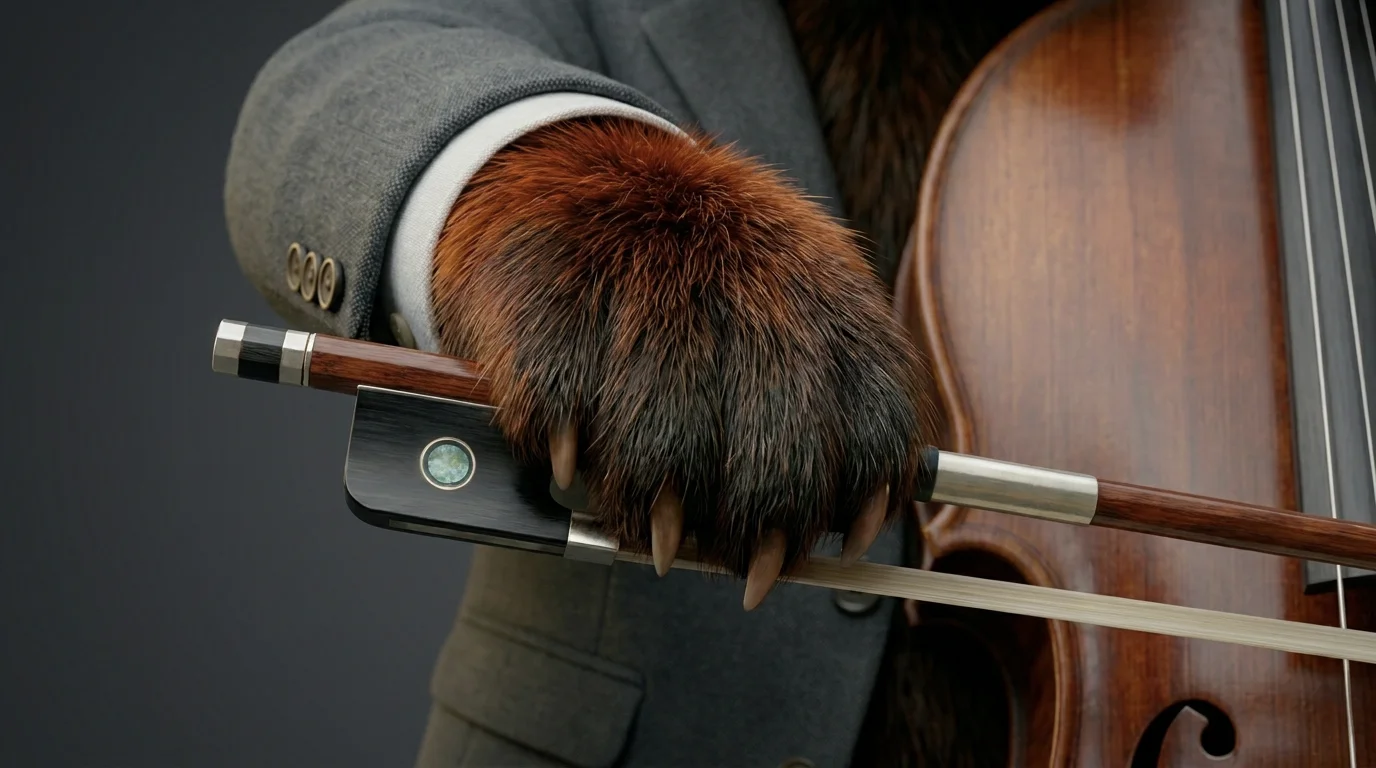
The middle finger is positioned opposite the thumb, falling flat onto the stick and perhaps even lightly touching the hair or the adjacent metal ferrule. If the wood were not there, the tip of the thumb would touch the first joint of the middle finger. The ring finger naturally finds its place next to the middle finger, resting gently on the mother-of-pearl dot (the eye) of the frog.
Index Finger (The Weight Transmitter)
The index finger should wrap around the stick slightly angled and spaced out, usually over the metal wire winding, making contact in the space between its first and second joints. Its primary function is to direct the weight of the arm and control the dynamic modulation of the sound.
Pinky Finger (The Balance Point)
Unlike the violin, the pinky on the cello does not sit on top of the stick. It should wrap around the wood, keeping the first joint flexed around the stick, roughly in the middle of the frog. The fingers should be flat on their middle phalanges and never point stiffly like spider legs.
Additionally, the knuckles of the hand should tilt slightly toward the tip of the bow. The wrist must remain aligned and relaxed, without unnatural bends that cause harmful tension.
Building Technique Through Preparatory Exercises
Because the cello bow is heavier than that of other string instruments and gravity exerts a different pull, it is recommended to start the process progressively.
Pencil or Straw Practice
Before using the real bow, the student can practice the grip on a pencil or a plastic straw. These light objects encourage a subtle grip, and in the case of the straw, it crushes immediately if the student squeezes the thumb, revealing the error.
The Docking Technique
To find the natural finger spacing, shake your relaxed hand freely in the air. Keeping this same distance and neutral shape, the hand descends from above toward the pencil (or bow) like a spaceship carefully docking at an orbital station.
Choking Up
When migrating to the real bow, the safest initial tactic is to hold it further up, near the balance point in the middle of the stick. This drastically reduces the sensation of weight at the tip, avoiding overload, until the hands are strong enough to gradually slide the grip down toward the frog.
Strengthening and Flexibility Exercises
To tone intrinsic muscles and weaker fingers (like the ring and pinky), cellists can do exercises like the "spider walk"—climbing up and down the length of the bow using only finger joints—and the "tornado," which consists of drawing circles in the air with the tip of the bow. Hanging the arm to simulate a monkey swinging (Tarzan hang) also helps ensure the correct resting weight of the fingers on the stick.
Arm Mechanics, Movement, and String Levels
The bow hold is just the final link in a long mechanical chain that starts in the back and travels down the arms. A full-bodied sound comes from the natural transfer of arm weight from the shoulder to the bow, requiring that the shoulders never be tensed up toward the ears, as this blocks the flow of weight.
Furthermore, the arm acts by adjusting heights according to the string being played. There are four basic right-arm levels:
- C String: Position where the elbow floats at its highest level, delivering a lot of weight to handle the thickest string.
- G String: The elbow lowers slightly from its upper initial position.
- D String: The arm level drops and settles a bit more.
- A String: Represents the lowest level, keeping the forearm almost parallel to the ground to facilitate bowing on the thinnest string without tension.
All bowing must follow a strictly straight path, perpendicular to the bridge, actively using the opening motion originating from the elbow, rather than simply bending and wearing out the wrist, which ruins contact and produces a scratchy sound.
Conclusion
The ultimate goal of the right hand is not merely to hold the wood statically, but rather to make the brain perceive the bow as an organic extension of the musician's own arm and body. The cellist's patience in focusing on initial mechanical exercises, gradually developing their musculature, and constantly monitoring their movements (preferably using mirrors) guarantees the absolute foundation necessary to produce rich, virtuosic art for a lifetime.
Explore More Articles