How to Tune Your Cello: A Step-by-Step Guide
Tuning a cello is one of the most vital skills for any cellist, from absolute beginners to seasoned professionals. A cello that is even slightly out of tune can hinder your progress and affect your ear training. At CelloEasy, we provide the visual tools you need to achieve pitch-perfect accuracy.
Understanding the Mechanics: Pegs vs. Fine Tuners
Your cello has two distinct mechanisms for adjusting the pitch of the strings. Understanding when to use each is key to preventing string breakage and maintaining bridge alignment.
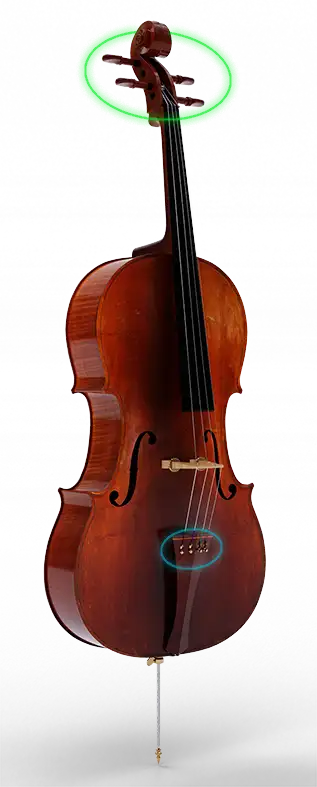
1. The Pegs (Coarse Tuning)
Located in the pegbox at the top of the instrument, these wooden friction pegs are used for coarse tuning. If your string is significantly flat or sharp, or if you have just installed a new string, you will use the pegs.
Pro Tip: Always push the peg inward toward the pegbox as you turn it to ensure the friction holds the string in place.
2. The Fine Tuners (Precise Tuning)
Located on the tailpiece, these small metal screws allow for precise adjustments. Fine tuners are ideal for daily maintenance and getting that perfect "green light" on the CelloEasy tuner. Turn clockwise to raise the pitch (sharpen) and counter-clockwise to lower it (flatten).
The Standard Cello Frequencies (Hz)
The cello is tuned in perfect fifths. Our chromatic tuner monitors these specific frequencies to help you reach the correct pitch:
- A String (1st/Thinnest): 220 Hz (A3)
- D String (2nd): 146.8 Hz (D3)
- G String (3rd): 98.0 Hz (G2)
- C String (4th/Thickest): 65.4 Hz (C2)
Step-by-Step Tuning Process
- Setup: Open the CelloEasy tuner and allow microphone access. Ensure you are in a quiet environment.
- Initial Check: Pluck the string (pizzicato) or use long, steady bow strokes. Check the note on the screen.
- Coarse Adjustment: If the note is more than a half-step away, use the pegs. Turn slowly!
- Fine Tuning: Once the CelloEasy needle is close to the center, use the fine tuners until the needle turns green.
- Re-check: Tuning one string changes the tension on the others. Always re-verify all four strings.
Frequently Asked Questions (FAQ)
You should tune your cello every time you sit down to play. Temperature and humidity changes cause the wood to expand and contract, shifting the pitch constantly.
Pegs are held by friction. If they slip, it might be due to a drop in humidity or the need for "peg dope" (a friction compound). Ensure you are pushing the peg in as you turn.
Yes, most cellists tune while in playing position. Use your left hand for the pegs and your right hand for bowing or plucking. For fine tuners, you can easily reach down while holding the instrument.
For fine tuning, using a long, steady bow stroke is better as it provides a continuous sound wave for the tuner to analyze accurately.